A student can now ask a chatbot to explain a difficult concept—or to produce an assignment without learning it. That is exactly why the future of education cannot be reduced to buying more software.
What the evidence says
- UNESCO’s teacher competency framework addresses human agency, ethics, AI foundations, pedagogy and professional learning.
- UNESCO’s 2026 reporting describes schools using clear supervised, teacher-directed and no-AI boundaries.
- The goal of technology in a classroom should be stronger learning and inclusion, not replacing teachers with unaccountable automation.
The most important feature is still the teacher
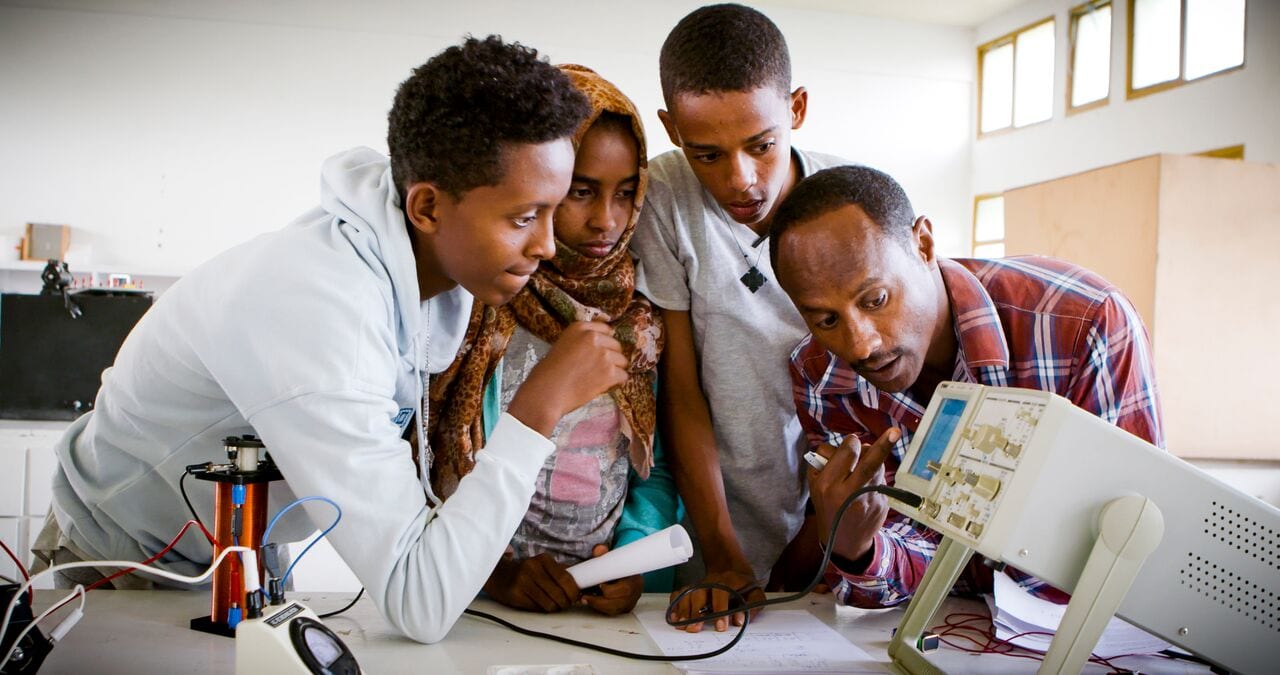
Technology can offer extra practice, translation assistance, accessibility options and feedback. A teacher can also notice that a child is frustrated, isolated or misunderstanding something the software appears to mark correct.
Good educational technology should make room for both: tools that support repetition and exploration, and educators who provide context, judgment, motivation and genuine relationships. UNESCO’s guidance explicitly places human agency and responsible design at the center.
Teach the tool—not just the prompt
AI literacy is not memorizing clever commands. Students need to distinguish confident language from evidence, verify claims, protect personal information and understand why a generated answer might be wrong.
An assignment can explicitly require source notes, drafts, oral explanation and reflection. Those practices are not anti-technology; they make the student’s thinking visible while permitting responsible tool use.
A practical classroom traffic light
UNESCO’s April 2026 reporting on schools in the United Arab Emirates described a traffic-light approach: red means the work must be the student’s own; amber permits teacher-directed technology; green permits supervised exploration. Other classrooms can adapt the principle to their own rules and age groups.
The key is clarity. Students should not have to guess which AI uses count as research, tutoring, translation or misconduct. Families and teachers should understand what data enters the system and how student work is assessed.
What schools should measure
A tool that looks exciting in a demonstration still needs to earn its place. Look for improved comprehension, reduced barriers for students with disabilities, better teacher time and demonstrably fair outcomes—not only hours spent in an app.
Schools should evaluate accessibility, procurement costs, data retention, vendor lock-in and whether children can complete essential tasks without the service. A private platform should not become the only route to public education.
Five habits students can build today
Ask the system for competing explanations, then inspect a textbook or a primary source. Rework an answer in your own words. Keep a record of what you could not verify. Practice hands-on experiments and conversations without screens. Learn how the tool stores or shares information.
Those habits are useful far beyond AI. The best educational future pairs powerful tools with stronger judgment, better access and genuine curiosity.
Sources & further reading
Sources below are primary institutional, research or regulatory publications. Reported results are not universal clinical outcomes.
Education editorial. Classroom technology policies and child privacy rules vary by school and jurisdiction.
Evidence before excitement.
Read carefully sourced technology reporting and practical tutorials. For unrelated computer support, SJK serves customers remotely nationwide and on site in DFW.
MORE SJK STORIES ↗GET TECH SUPPORT ↗