A thought-controlled arm is impressive. An arm that also returns a meaningful sense of touch could be life-changing. At the University of Utah, researchers are finally testing that experience beyond the laboratory.
What the evidence says
- In September 2026, University of Utah Health reported a home trial of its nerve-connected LUKE Arm with a direct nerve interface.
- The system uses neural input for control and sends sensory information back to the participant; it is being evaluated in a research setting.
- A successful home trial is not the same thing as an FDA authorization for general sale, a cure for limb loss, or a device suitable for every patient.
Why this arm matters
Most powered prosthetic hands rely on electrical signals from remaining muscles to open, close or switch grip patterns. That can restore useful function, but a person may still have to watch the fingers constantly. Without natural feedback, a grip that seems secure may be too strong for a fragile object or too weak to hold a glass.
The University of Utah program explores a different loop. Implanted nerve interfaces carry intended movement signals toward the robotic arm while conveying touch-related feedback in the opposite direction. The goal is not simply an advanced gripper: it is a hand that can participate in more natural everyday actions.
A participant brings research into his home
University of Utah Health reported that Alexander “Avi” Davidson became the first participant in a home trial of the LUKE Arm and BIOS Controller. Activities described by the institution include writing, handling cards, preparing food and holding a family member’s hand. Those are reports from a trial, not proof that every user will experience identical results.
Home use is a tougher test than laboratory demonstrations. The system must be safe, dependable, intuitive and practical over many months. Researchers must also measure the training burden, maintenance needs and what happens when real life departs from carefully controlled study conditions.
What the breakthrough does not prove
No credible interpretation is that robotic hands have suddenly become indistinguishable from biology. Battery life, durability, cost, surgical suitability, rehabilitation, insurance coverage and long-term outcomes still matter. The home trial follows a small number of research participants.
The practical question is whether sensory feedback leads to better independence, lower mental effort and satisfaction in daily living—without disproportionate medical or technical burdens. A breakthrough-device designation helps an experimental device communicate with regulators; it does not itself authorize general marketing.
The larger bionics opportunity
Bionics sits where mechanical engineering, embedded computing, physiology, signal processing and physical therapy meet. A camera or sensor is useful only when the complete human-machine loop is comfortable, reliable and responsive.
Future progress may come from better electrodes, lower-power processors, durable soft materials and more personalized rehabilitation—not a single futuristic-looking arm. The people using these devices should lead how researchers define success.
The SJK perspective
The story to watch is not “robots replacing people.” It is technology returning meaningful control to people. That demands a patient-first definition of success and careful reporting about experimental status.
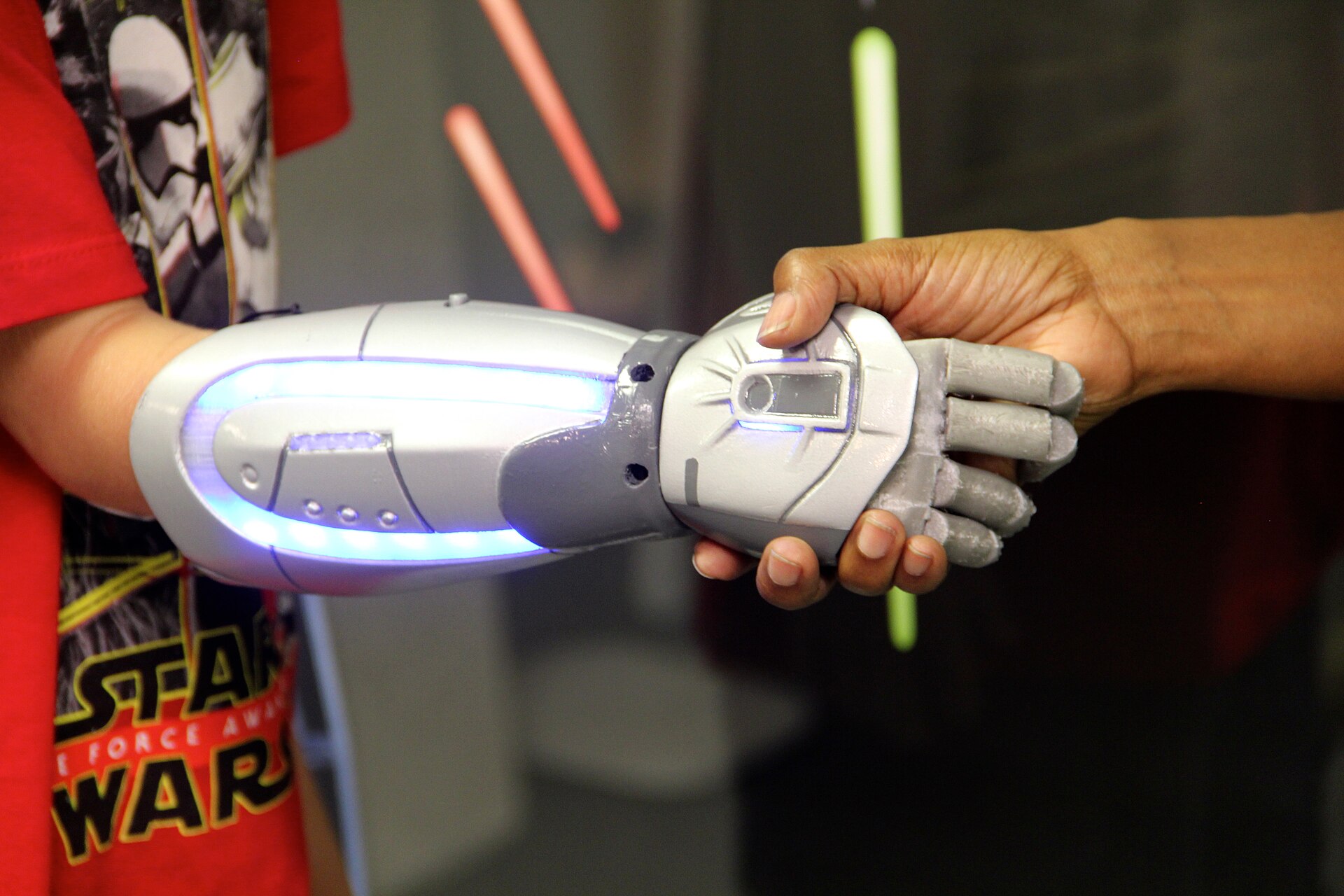
A real prosthetic device in an older archival cover photograph is illustrative only; it is not the LUKE Arm in the Utah trial. The medical findings come from the named research institutions and published studies, not from the cover image.
Sources & further reading
Sources below are primary institutional, research or regulatory publications. Reported results are not universal clinical outcomes.
Medical research reporting. This is not treatment advice or a statement that the experimental device is publicly available.
COVER IMAGE: StarWarsRey / Wikimedia Commons (CC BY-SA 4.0); 2015 3D-printed prosthetic hand, not the Utah LUKE Arm.
Evidence before excitement.
Read carefully sourced technology reporting and practical tutorials. For unrelated computer support, SJK serves customers remotely nationwide and on site in DFW.
MORE SJK STORIES ↗GET TECH SUPPORT ↗