Europa is already strange enough without a fabricated signal beneath its ice. Real spacecraft observations point to a global ocean hidden under a fractured shell, and an active NASA mission is on its way to investigate the conditions that make worlds habitable.
Three facts to start with
- Multiple lines of evidence support an ocean of salty liquid water beneath Europa’s ice.
- Europa Clipper launched in 2024 and is expected to reach the Jupiter system in 2030.
- No confirmed life, message, organism or alien signal from Europa has been detected.
What spacecraft have already seen
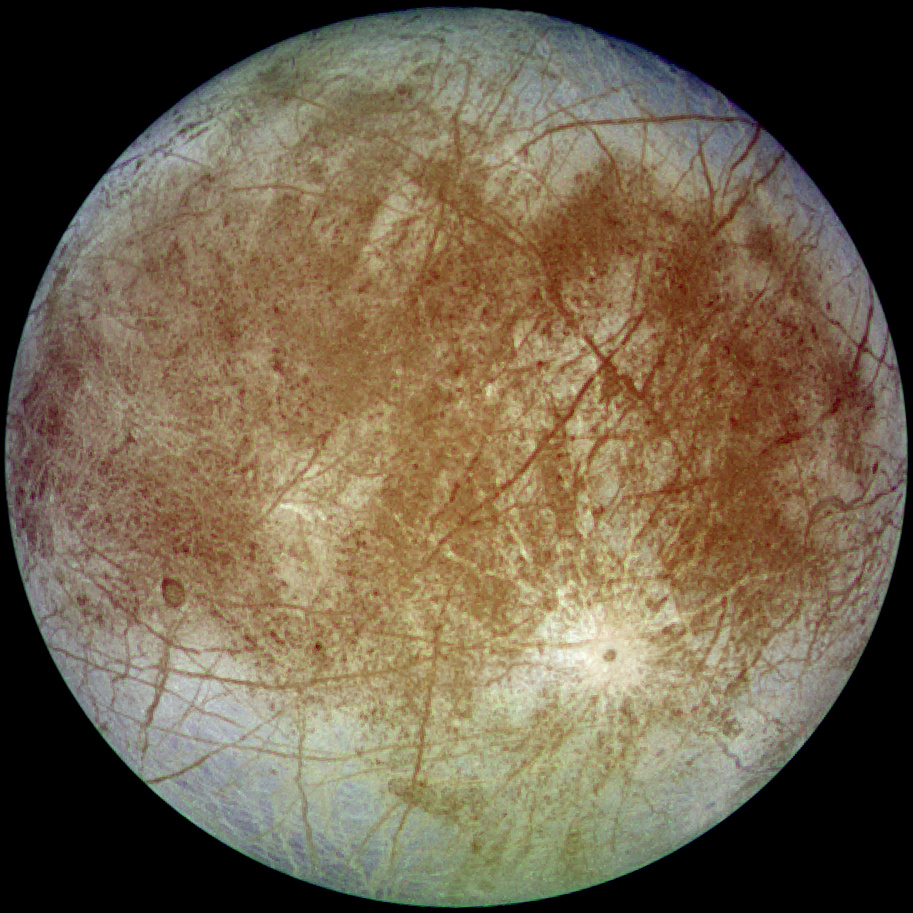
Voyager images suggested Europa had a surprisingly smooth, young icy surface. Galileo later observed detailed fractures and surface formations that were consistent with movement of material beneath an ice shell. Measurements of magnetic-field behavior provided strong evidence for a conductive salty liquid layer.
The simplest supported explanation is a global subsurface ocean, although precise ocean properties remain an active topic of research. That conclusion comes from orbital measurements and planetary physics, not from a probe drilling into an ocean.
What lies beneath the ice?
NASA describes an ice shell potentially on the order of 10 to 15 miles thick, with an ocean beneath. Estimated dimensions depend on models and remain uncertain. Tidal flexing from Jupiter and interactions with the rocky interior may affect Europa’s energy budget.
Water is a promising starting point for biology, but organisms also need useful chemistry, energy and suitable environmental stability. Finding one ingredient is not the same as finding living cells.
The Europa Clipper mission is real
NASA launched Europa Clipper on October 14, 2024. The mission targets arrival at Jupiter in April 2030 and plans repeated close flybys of Europa to study its ice shell, internal ocean and surface composition.
The spacecraft is not a submarine and is not currently tunneling through Europa’s crust. It is a remote scientific investigation designed to determine whether places on Europa could have conditions suitable for life.
How a mission can test habitability
Radar can help probe the subsurface, cameras map geology, and other instruments assess composition, temperature and magnetic properties. By combining measurements, scientists can strengthen or revise models of how Europa works.
The mission may also help scientists identify promising locations and questions for future exploration. It does not guarantee discovery of organisms, and its primary objective is not direct life detection.
What scientists still do not know
Researchers do not yet know the exact depth, salinity, chemistry or habitability of Europa’s ocean, or whether organic materials can move between the surface and its interior in biologically useful ways. The evidence for an ocean is strong, but the evidence for actual life is absent.
Any future sample or signal claiming extraterrestrial biology would require extraordinary contamination controls and independent corroboration. That is a more compelling story than an invented encounter.
Why this belongs in Future Lab
Europa is an example of evidence-based futurism: documented observations create precise questions for a spacecraft that already exists. The outcome is uncertain, but every instrument has a job and every claim has a test.
The moon may teach us how habitable environments arise beyond the traditional “Goldilocks zone” around stars. We do not need imagined ocean civilizations to make that scientifically extraordinary.
Primary sources & research
This independent SJK explainer uses public scientific observations and research. Evidence can evolve; follow the linked research agencies for updated findings.
Cover: NASA Galileo mission / publicly archived image of Europa’s fractured icy surface. Image source / archive. An actual spacecraft or telescope image is not a photograph of a future event.