Saturn is the planet every child can identify in an illustration. But what spacecraft revealed is richer: icy fragments masquerading as solid rings, giant storms, a moon with methane lakes and another moon spraying water into space.
Three facts to start with
- Saturn is a gas giant made mostly of hydrogen and helium, not a planet with a ground surface to stand on.
- NASA listed 293 confirmed Saturnian moons as of August 2026; moon counts change with discoveries.
- Titan has methane lakes; Enceladus contains a global subsurface ocean and active water-rich plumes.
A planet made mostly of gas
Saturn is the sixth planet from the Sun and the second largest in our solar system. It is composed largely of hydrogen and helium, with pressure and temperature increasing dramatically into the planet’s interior.
There is no ordinary solid surface where a spacecraft could simply land and plant a flag. Descending into Saturn would confront dense, turbulent gas and extreme conditions long before any stable place to stand.
The rings are countless pieces, not a disk
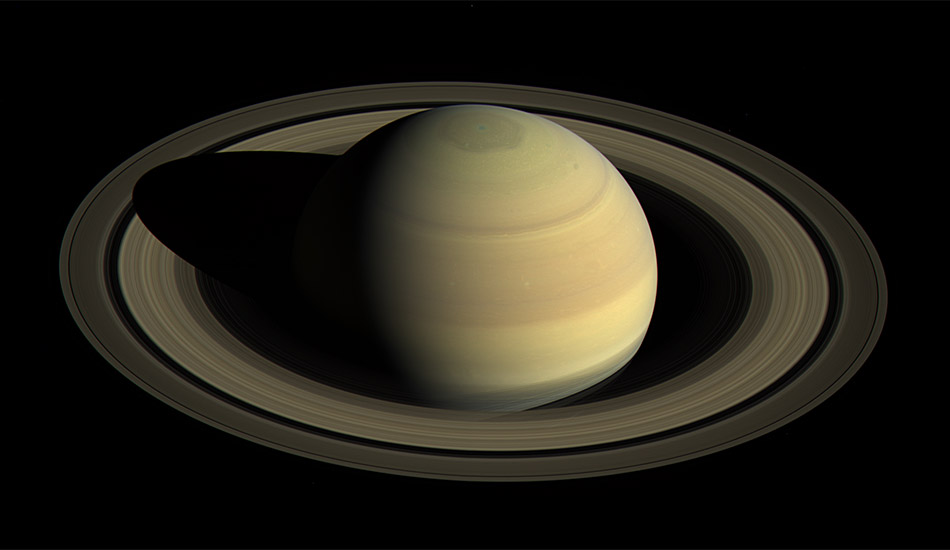
Saturn’s bright rings are made from enormous numbers of icy particles and fragments. Seen from a distance they resemble smooth bands; close spacecraft observations reveal gaps, waves, gravitational structures and material interactions with moons.
The broad ring system is extremely thin compared with its enormous width. Cassini’s views show that the rings are a dynamic environment, not a static object that has always looked the same.
A Saturn day is shorter than you might expect
NASA describes Saturn’s rotational period as about 10.7 hours. The giant planet takes approximately 29.4 Earth years to complete one orbit of the Sun. Its axis is tilted, so Saturn experiences seasons even though a Saturnian year lasts almost three decades.
Sunlight takes roughly 80 minutes to travel from the Sun to Saturn at Saturn’s average solar distance. Radio communication with a spacecraft near Saturn also has significant delay: messages travel at light speed and cannot provide instantaneous joystick-style control.
Titan: lakes without liquid water on the surface
Titan is larger than Mercury and has a thick atmosphere. Instead of Earth-like seas, it has lakes and rivers of liquid methane and ethane in a profoundly cold environment. That makes it an extraordinary laboratory for organic chemistry and weather unlike our own.
Titan is not an easy second Earth. It combines extreme cold, very different chemistry and a dense nitrogen-rich atmosphere. But its variety makes it scientifically compelling for future robotic exploration.
Enceladus: an ocean beneath the ice
NASA’s Cassini observed plumes escaping from Enceladus and helped establish evidence for a global salty ocean beneath its ice. Those plumes carry samples of internal material into space, raising the possibility of studying ocean chemistry without drilling through kilometers of ice.
An ocean and life-supporting ingredients are not proof of life. No confirmed organism has been found on Enceladus. That distinction is the same one responsible reporting should apply to Europa.
Why the moon count changes
Saturn’s confirmed-moon tally can rise as astronomers identify faint objects and confirm their orbits. NASA’s moons page listed 293 confirmed moons as of August 2026. Older NASA pages may show a lower total because new discoveries changed the count.
The number is a dated census, not an eternal fact. The real story is the astonishing range of worlds in one planetary system—from Titan’s dense atmosphere to Enceladus’s jets and tiny irregular objects on distant paths.
What Cassini left us
The Cassini spacecraft ended its mission in 2017, but its photographs and instrument data still support research today. It transformed the ring system from a distant curiosity into a place scientists can study dynamically and compare with the formation of disks elsewhere in astronomy.
That is why archived mission imagery is worth using: the pictures are real measurements with provenance, not generic AI artwork pretending to be the cosmos.
Primary sources & research
This independent SJK explainer uses public scientific observations and research. Evidence can evolve; follow the linked research agencies for updated findings.
Cover: NASA/JPL-Caltech/Space Science Institute; Cassini spacecraft Saturn observation, 2016. Image source / archive. An actual spacecraft or telescope image is not a photograph of a future event.