Science fiction makes a galaxy jump look like a night flight. Actual astronomy makes it a distance problem so extreme that even an extraordinary spacecraft would confront millions of years of travel by Earth clocks.
Three facts to start with
- NASA places Andromeda about 2.5 million light-years from Earth.
- At 10% of light speed, a straight-line journey would take roughly 25 million years in the galaxy’s rest frame, ignoring acceleration.
- No demonstrated propulsion system can take humans across intergalactic distances, and no verified faster-than-light drive exists.
First, the scale is almost impossible to picture
A light-year measures distance, not time: it is how far light travels in one year through vacuum. Proxima Centauri, our nearest stellar neighbor, is about 4.24 light-years away. The Andromeda galaxy is roughly 2.5 million light-years away.
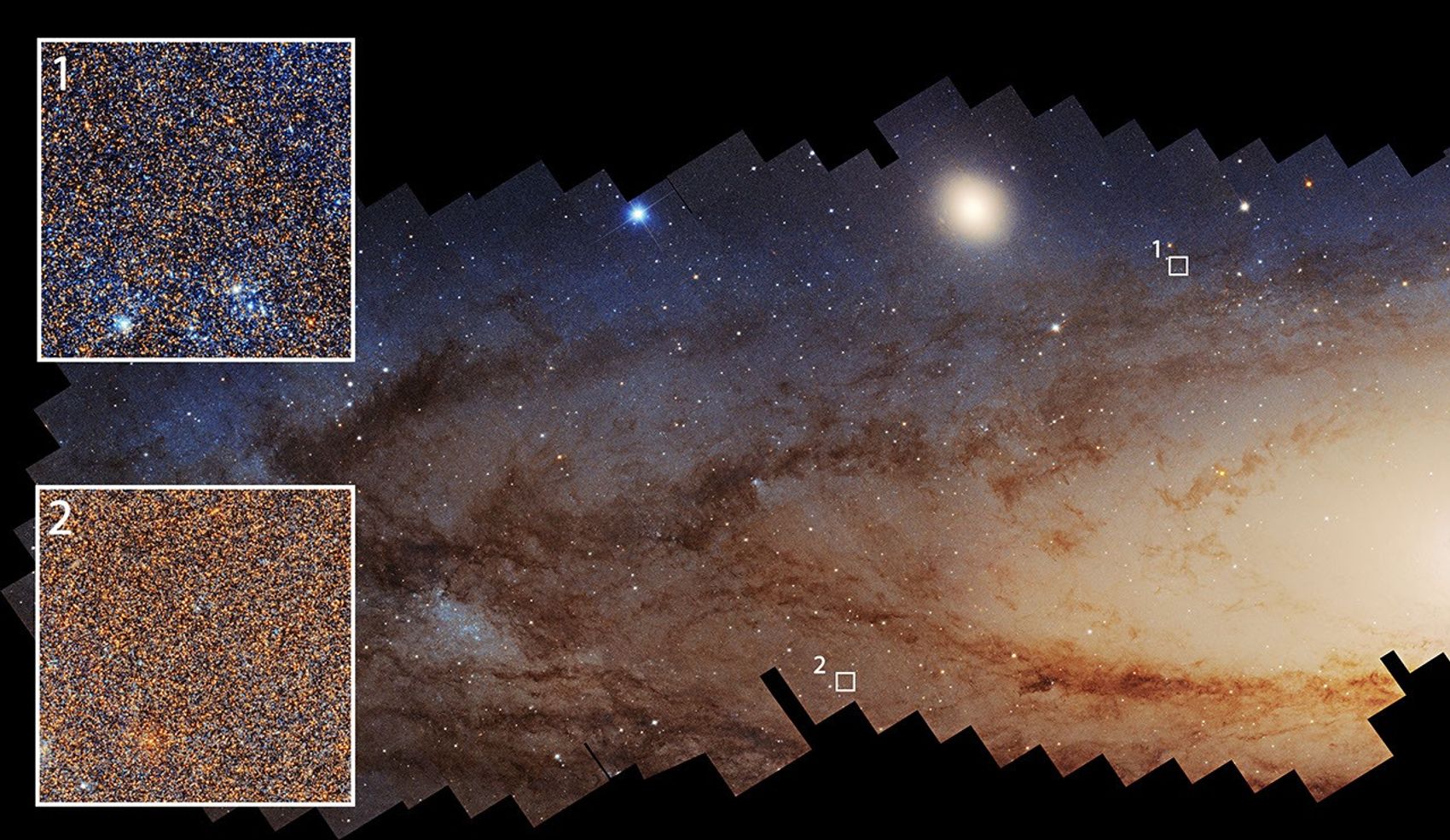
The difference between traveling to another star and another galaxy is so vast that a technology capable of the former would not automatically make the latter practical. NASA’s Hubble telescope observes Andromeda as it looked 2.5 million years ago because the light has spent that long arriving here.
Put real numbers on a futuristic ship
At ten percent of the speed of light—much faster than any human spacecraft has achieved—the approximate one-way cruise time to Andromeda would be 25 million years, ignoring acceleration, deceleration and orbital motion. At ninety percent of light speed, the Earth-frame cruise time would still be around 2.8 million years.
Relativity changes the amount of time passengers would experience at extreme speeds, but it does not make intergalactic distances trivial. Energy requirements, shielding against interstellar particles, spacecraft reliability, navigation and the need to slow down would be extraordinary challenges.
Could a generation ship work?
A multi-generation spacecraft is a theoretical concept in which descendants of an original crew complete the journey. It would require a civilization-scale closed ecosystem capable of preserving health, culture, food production, manufacturing and governance for timescales far longer than any recorded human civilization.
Cryogenic suspension is another common idea, but reliable, reversible human suspended animation for such journeys has not been demonstrated. Neither idea is an existing solution; each merely relocates the biggest difficulty from propulsion to biology and systems reliability.
Why “warp drive” does not solve the problem today
General relativity allows mathematicians to write exotic spacetime geometries, including warp-bubble proposals. But a mathematical solution is not a workable engine. Many models invoke negative energy or other physical requirements without a demonstrated method for construction or control.
No controlled experiment has shown macroscopic faster-than-light travel, wormhole transit or a device that shortens millions of light-years into a routine voyage. Claims of imminent intergalactic travel should therefore be treated as speculative, not a development roadmap.
What exploration might realistically look like first
Robotic flyby probes, long-duration autonomous observatories, powerful telescopes and extremely fast interstellar microprobes are more grounded starting points than passenger ships. A tiny probe may have very different engineering demands than a crewed vehicle carrying oxygen, shielding, food and medical systems.
Future astronomers might study planets in other galaxies remotely long before a craft ever approaches them. Better spectroscopy, computational modeling and gravitational-lensing techniques could transform our knowledge without crossing the gulf.
The honest conclusion
Traveling to Andromeda does not violate the idea that a craft can move through space, but known constraints render a human expedition unimaginably difficult. We cannot responsibly promise it will happen in the next century or in any specified millennium.
The interesting questions are still worth asking: can we build reliable probes for centuries, harness far greater propulsion energy, or find new physical principles? The answers must emerge from testable engineering and observation rather than a fictional departure schedule.
Primary sources & research
This independent SJK explainer uses public scientific observations and research. Evidence can evolve; follow the linked research agencies for updated findings.
Cover: NASA/ESA/Hubble (2026), star-formation mosaic of Andromeda; telescope observations, not a depiction of a spacecraft voyage. Image source / archive. An actual spacecraft or telescope image is not a photograph of a future event.