
The question “Who is winning technology?” assumes there is one scoreboard. There is not. China produces important research, dominates parts of industrial manufacturing and has globally popular open AI models. The United States still commands a substantial lead in frontier-AI compute and many top-end models. Both facts can be true at once, and neither makes the entire world a winner-take-all contest.
What readers should know
- ASPI’s June 2026 tracker places China first in high-impact research output in 69 of 74 tracked technologies. It measures papers, not overall product quality or commercial market share.
- A November Lowy Institute comparison finds the U.S. leads in available AI compute, advanced AI chips and frontier model performance, although assumptions and estimates matter.
- Technology leadership includes research, manufacturing, adoption, supply chains, talent, security and open standards—not a single number.
What 69 out of 74 technologies actually means
The Australian Strategic Policy Institute tracks the concentration of highly cited scientific research across selected critical technologies. In its 2026 update, China leads 69 of 74 fields by the study’s high-impact publication metric. That signals a significant transformation in research capacity and should not be dismissed.
But a leadership rank in papers cannot be converted directly into “China manufactures 93 percent of the best technologies.” Researchers publish discoveries years before the underlying products are reliable, commercial or globally adopted. Different measures will produce different leaders.
Where the United States still has a large advantage
The Lowy Institute’s November 8 snapshot estimates the U.S. leads in frontier AI models and available compute, with substantially more advanced computing hardware in data centers. Its methodology estimates U.S. data centers have roughly forty times China’s AI processing capacity; that is an estimate tied to definitions, not a certified count of every computer.
U.S. semiconductor designers, hyperscale cloud platforms, software ecosystems and research institutions remain globally consequential. American leadership is real, but that strength does not remove supply-chain dependence on partners in Taiwan and elsewhere.
Where China is formidable
China has deep manufacturing scale, important shares of critical-mineral processing and a fast-moving open-model ecosystem. Lowy describes Chinese open models as widely downloaded; openness and distribution can spread influence even when frontier benchmarks favor a U.S. lab.
Industrial robotics, batteries, clean-energy supply chains, consumer hardware and rapid deployment deserve attention beyond the AI chatbot race. The strategic opportunity is to understand which specific products and processes are strong—not assign a simplistic winner to an entire country.
Taiwan is not an interchangeable footnote
Taiwan’s chipmaking and memory ecosystem is a separate economic and political actor with its own companies and strategies. A U.S.–China comparison that ignores TSMC, Nanya, equipment makers in Europe and Japan, and customers worldwide leaves out essential pieces.
For example, Nanya’s announced Fab 5A expansion is a Taiwan-based effort to serve demand across DRAM generations and AI infrastructure. It is not “proof” of Chinese mainland control over the global memory market.
Cooperation and competition can both help innovation
International research exchange, safer AI standards and legitimate trade can accelerate useful technologies. Strategic rivalry can also push governments to invest in chips, energy systems and education. The risk is turning every business relationship into a loyalty test or every scientific result into a military threat.
Brookings researchers argue that limited AI safety coordination is possible even when the United States and China remain competitors. CSIS warns that poorly calibrated export controls may create unintended economic and technological costs. Those are policy arguments worth examining, not unquestionable conclusions.
What consumers and businesses should follow
Look at product reliability, privacy policy, independent security testing, supportability, standards and total cost. A technology can offer value regardless of where it was invented, but procurement also has legal and data-security obligations that differ by use case.
The most accurate answer in November 2026 is that China leads some critical technologies, the United States leads others, and the measurements often capture different things. Precision is more useful than a flag in the headline.
Editorial method: Current findings are attributed to the sources below. A preliminary explanation is not a final investigative conclusion; projections, allegations and buying advice are explicitly distinguished from established events.
Sources & further reading
Reporting as of November 15, 2026. Source statements, industry forecasts and independent analysis are distinguished in the article. Photo credits are below.
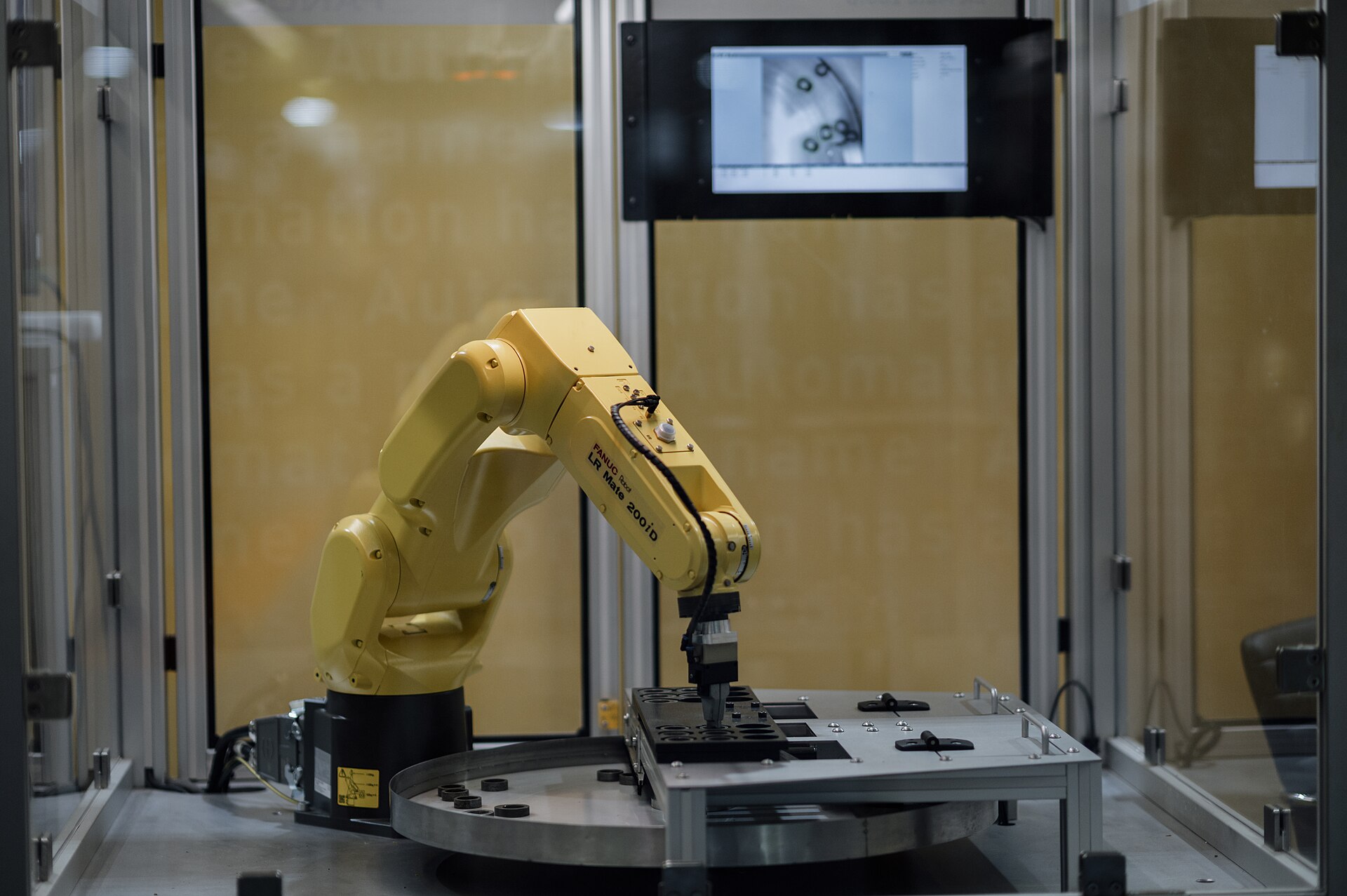
Photograph: Shixart1985 / Wikimedia Commons, CC BY 2.0 (resized). Original photograph, attribution and reuse terms. Real robotic arm in an engineering laboratory in May 2026; not evidence of a specifically Chinese facility.
 SECURITY / GLOBAL TECHThe China Chip-Spying Question
 CHIPS / TAIWANTaiwan Is Building More DRAM. That Won’t Fix Memory Prices Overnight.
 INFRASTRUCTURE / AVIATIONWhat Really Shut Down U.S. Flights: The FAA’s November 13 Network Failure